Key Measures are repeatable assemblies from which multiple products can be derived, so you have to measure less. Instead of measuring every individual SKU Product, you use a single Key Measure, and Pipeline LBM converts it into the correct list of orderable Products using predefined Calculations and rules.
Key Measures enable estimators to standardize assemblies, streamline takeoffs, and generate accurate Bills of Materials (BOMs).
How Key Measures Work
A Key Measure receives a quantity from your takeoff (for example, linear feet of exterior wall). Pipeline LBM then applies the Key Measure’s structure and Calculations to break that input into the SKU Products that make up the assembly.
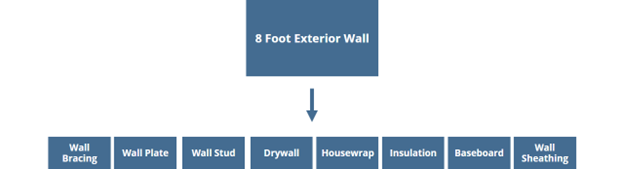
A Key Measure:
- Expands into multiple SKU Products when generating the Job BOM.
- Uses Calculations to convert the takeoff quantity into material counts.
- Ensures consistency and accuracy across all Jobs.
- Standardize assemblies across your organization.
- Reduce manual entry and repetitive calculations.
- Improve accuracy in estimating and BOM generation.
- Produce predictable outputs that align with SKU-level inventory and pricing.
Example: Exterior Wall Assembly
Consider an exterior wall measured in linear feet during takeoff:
- You import the linear-foot wall measurement into Pipeline LBM as a Key Measure quantity.
- Pipeline LBM identifies the SKU Products assigned to that Key Measure—such as studs, plates, bracing, sheathing, or baseboard.
- Pipeline applies each Calculation to determine how many of each SKU Product are required.
- The generated Bill of Materials displays the individual SKU Products, not the Key Measure placeholder.
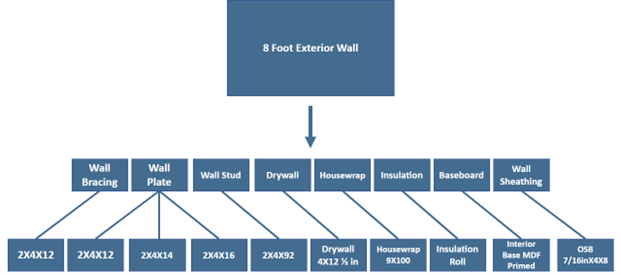
This conversion is part of Pipeline LBM’s Estimating Logic, which ensures your assemblies tie directly into your back-office systems for pricing, bids, and material lists.